
What is On-Page SEO? A Complete Beginner’s Guide to On-Page SEO
Making quality content for your website is just one aspect of getting found online. Additionally, you must ensure that each page is easily readable, navigable, and usable by search engines. On-Page SEO is crucial in this situation.
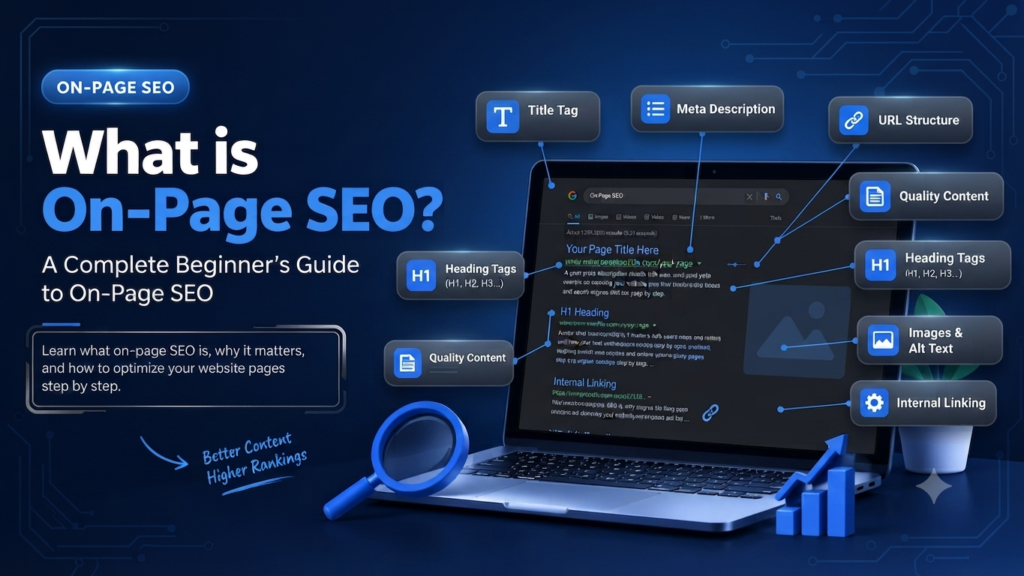
To put it simply, On-Page SEO is the process of making improvements to your websites so that visitors can more quickly access relevant information and search engines can comprehend your material. Titles, headings, URLs, content, internal links, pictures, and the user experience as a whole are all included.
Google’s current guidelines still place a strong emphasis on basic SEO techniques and helpful, trustworthy, people-first content. These principles also hold true as Google Search incorporates more AI-powered features.
Understanding On-Page SEO provides you with a useful basis for enhancing your website, regardless of whether you are a blogger, a business owner running a website, or a novice studying digital marketing.
What Is On-Page SEO?
The optimization of components that are immediately on a webpage is known as “on-page SEO.” The objective is to improve the page’s comprehensibility for both users and search engines.
Because search engines must evaluate a webpage’s content, structure, and purpose before determining how it connects to a user’s search query, it is a crucial component of search engine optimization.
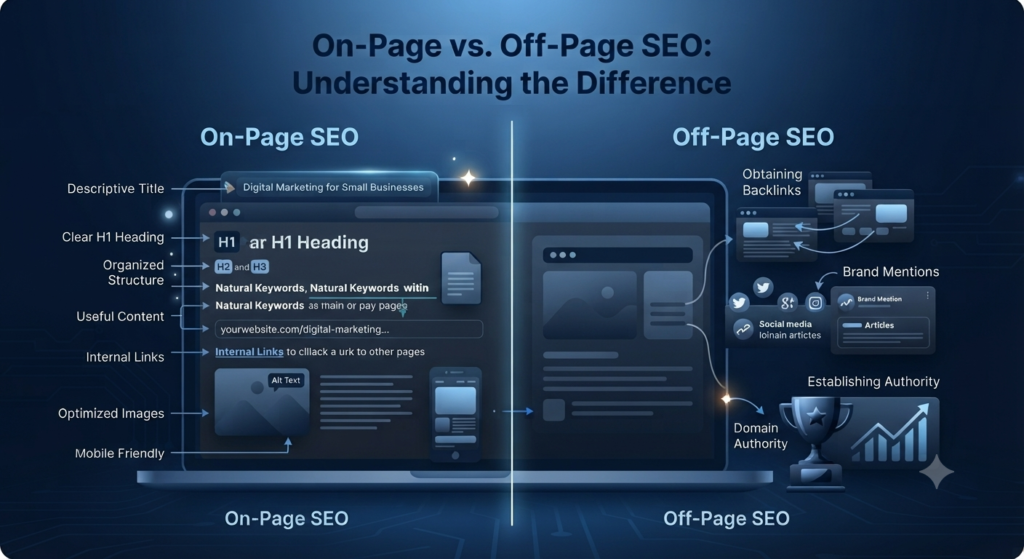
Assume, for instance, that you write a piece titled “digital marketing for small businesses.” Appropriate website optimization may entail:
Creating a descriptive title
Using a clear H1 heading
Organizing information with H2 and H3 headings
Naturally using relevant keywords
Writing useful and original content
Creating a readable URL
Adding relevant internal links
Optimizing images and alt text
Making the page easy to use on mobile devices
The website itself is where this kind of SEO optimization mostly takes place.
Off-Page SEO, which typically entails actions outside of your own webpage, such as obtaining backlinks, creating brand mentions, and establishing online authority, is distinct from On-Page SEO.
Why Is On-Page SEO Important?
In addition to enhancing the user experience, effective on-page SEO can assist search engines in comprehending the topic and applicability of a webpage.
It matters for the following significant reasons:
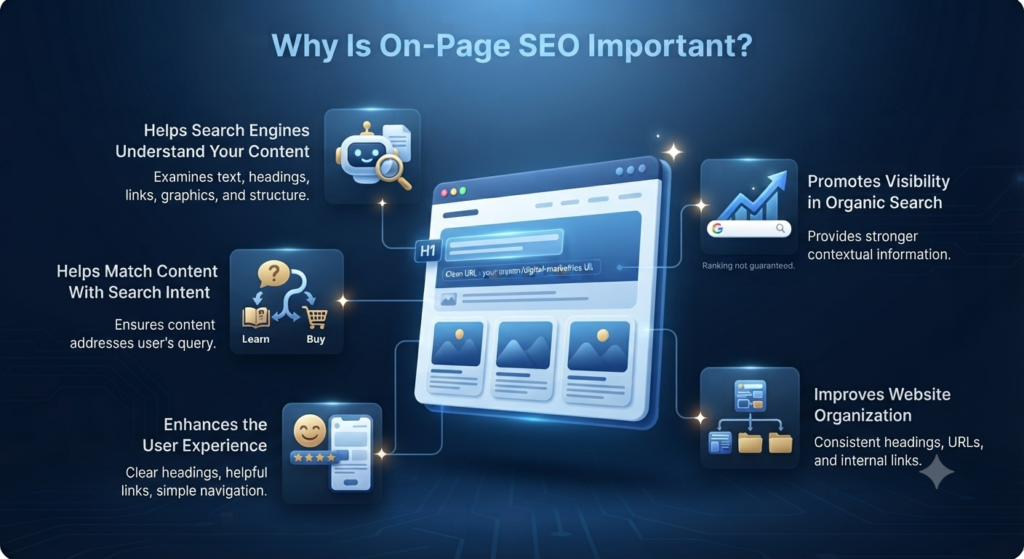
1. Helps Search Engines Understand Your Content
A webpage’s text, headings, links, graphics, and page structure are all examined by search engines. A page’s topic is easier to understand when it has clear material and descriptive details.
2. Helps Match Content With Search Intent
The purpose of a search for “what is SEO?” differs from that of a search for “SEO agency near me.” You may produce content that truly addresses the visitor’s search query by having a thorough understanding of search intent.
3. Enhances the User Experience
Search engines are just one aspect of effective SEO. A page is more user-friendly when it has clear headings, intelligible content, helpful links, optimized pictures, and simple navigation.
4. Promotes Visibility in Organic Search
Stronger contextual information about a page’s content can be provided to search engines through optimization. But optimization by itself does not ensure a specific ranking. Google makes it clear that crawling, indexing, and ranking are not guarantyd by adhering to SEO best practices.
5. Improves Website Organization
A website can be made easier for users and search engines to navigate by using consistent headings, URLs, internal links, and well-organized material.
How Does On-Page SEO Work?
Lorem ipsum dolor sit amet, consectetur adipiscing elit. Ut elit tellus, luctus nec ullamcorper mattis, pulvinar dapibus leo.
Automated systems are used by search engines to find, crawl, comprehend, and index webpages. As a result, your page should make it obvious what its subject and goal are.
Important elements include:
Page content: Provides a thorough explanation of the topic.
Keywords: Describe the vocabulary that users use when conducting searches.
Title tag: Provides a concise description of the page.
Headings: Divide the text into sections that make sense.
Meta description: Can summarize the page for users in search results.
URL: Offers an additional informative signal about the page.
Internal links: Link similar pages together on your website.
Images: When correctly optimized, they can complement the written information.
Search intent: Assists in making sure the user’s purpose is met by the content.
In particular, Google’s Search Essentials advises employing terms that readers might use to find your material in prominent and descriptive places like headings, titles, alt text, and link text.
Important On-Page SEO Factors
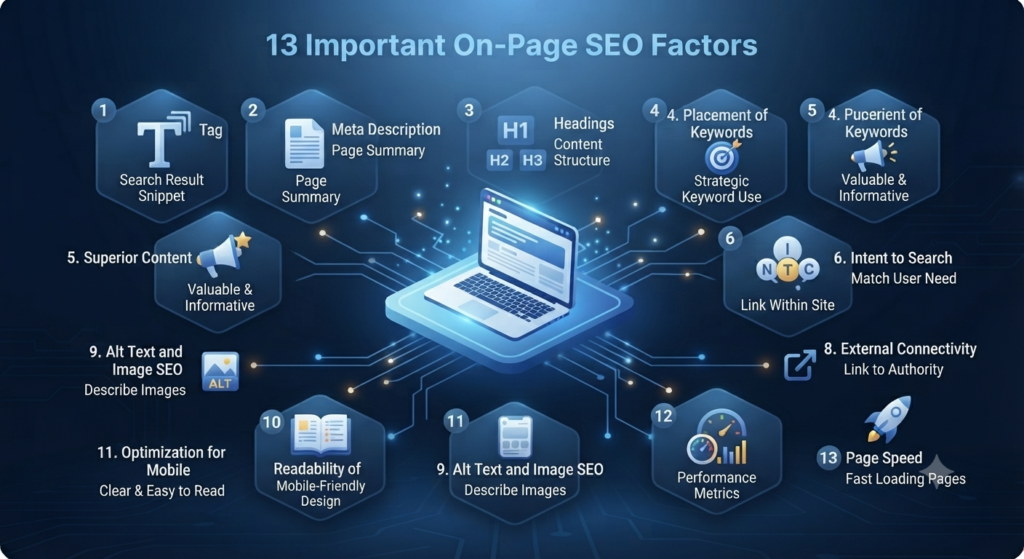
1. The title tag
One of the first things visitors may see when your website shows up in search results is the title tag.
A good title should be pertinent to the page, succinct, and descriptive.
For instance:
Bad: Homepage
Better: A Comprehensive Beginner’s Guide to On-Page SEO
Google advises against ambiguous or overly lengthy titles in favor of clear and succinct title language.
2. Meta Description
A brief synopsis of a webpage is given in a meta description. A helpful description can assist viewers understand what to expect from the page, even though it is more than just a tool for adding keywords.
For instance:
Discover the most crucial optimization elements, learn what On-Page SEO is, and use a useful checklist to enhance your website.
Make the description of each significant page distinct and pertinent.
4. Headings
Your content is arranged using headings.
A common structure might be:
H1: What Is On-Page SEO?
H2: Why Is On-Page SEO Important?
H2: Important On-Page SEO Factors
H3: Title Tag
H3: Meta Description
H3: Internal Linking
Make use of a single, distinct H1 and use H2 and H3 headings to logically arrange supporting sections.
5. Placement of Keywords
On-Page SEO vs Off-Page SEO
| Aspect | On-Page SEO | Off-Page SEO |
|---|---|---|
| Where it happens | On your website | Outside your website |
| Main focus | Content and webpage elements | External signals and visibility |
| Examples | Titles, headings, content, URLs | Backlinks, mentions, outreach |
| Main purpose | Help users and search engines understand your pages | Build external visibility and authority |
| Direct control | Generally high | Generally lower |
Both areas can be part of a broader SEO strategy. They address different aspects of improving a website’s presence online.
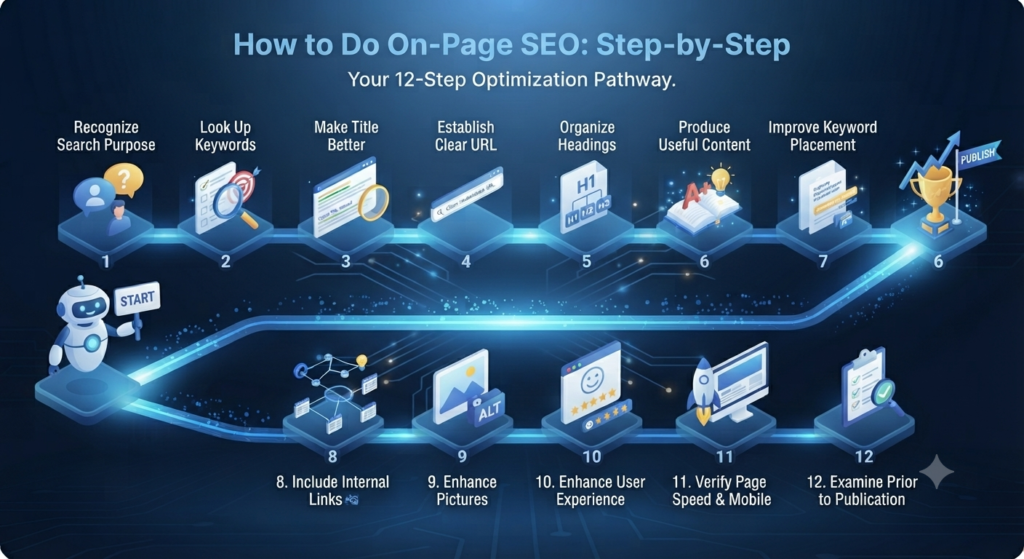
How to Do On-Page SEO: Step-by-Step
You can use this useful method if you’re wondering how to do on-page SEO.
Step 1: Recognize the purpose of the search
Find out what the searcher truly wants to know before you start writing.
Step 2: Look Up Keywords
Determine the primary keyword and any associated terms that your target audience might use.
Don’t limit your attention to search volume alone. Recognize the significance of the questions.
Step 3: Make the Title Better
Make a title that appropriately describes the page and is clear and pertinent.
Step 4: Establish a Clear URL
Make use of a succinct, informative URL that captures the essence of the page.
Step 5: Organize Your Headings
To make it easier for readers to scan the material, create a logical H1, H2, and H3 structure.
Step 6: Produce Useful Content
Provide precise, unique, and helpful answers to the reader’s inquiries.
Step 7: Improve the Placement of Keywords
Instead of cramming the major and associated terms into every paragraph, use them organically.
Step 8: Include Internal Links
Link the article to other pertinent pages on your website.
Step 9: Enhance Pictures
When appropriate, use alt text and pertinent photos.
Step 10: Enhance User Experience and Readability
Make the page easy to read, navigable, and visually clear.
Step 11: Verify Page Speed and Mobile-Friendliness
Evaluate the page’s performance by testing it on mobile devices.
Step 12: Examine Prior to Publication
Verify the title, headings, links, photos, formatting, grammar, search purpose, and general usefulness.
Effective on-page SEO optimization is built on this entire process.
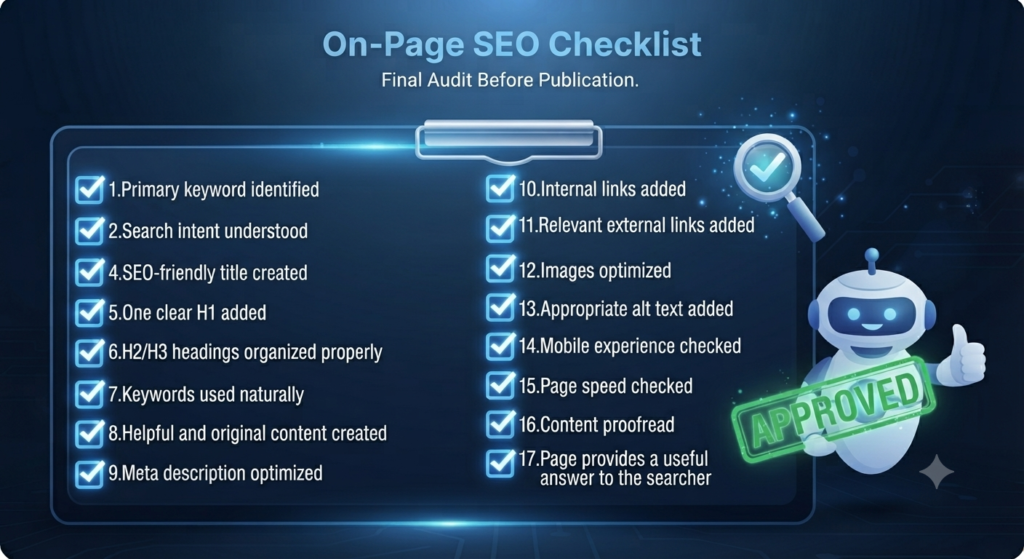
On-Page SEO Checklist
Use this on-page SEO checklist before publishing a webpage:
- ☐ Primary keyword identified
- ☐ Search intent understood
- ☐ SEO-friendly title created
- ☐ Optimized URL created
- ☐ One clear H1 added
- ☐ H2/H3 headings organized properly
- ☐ Keywords used naturally
- ☐ Helpful and original content created
- ☐ Meta description optimized
- ☐ Internal links added
- ☐ Relevant external links added
- ☐ Images optimized
- ☐ Appropriate alt text added
- ☐ Mobile experience checked
- ☐ Page speed checked
- ☐ Content proofread
- ☐ Page provides a useful answer to the searcher
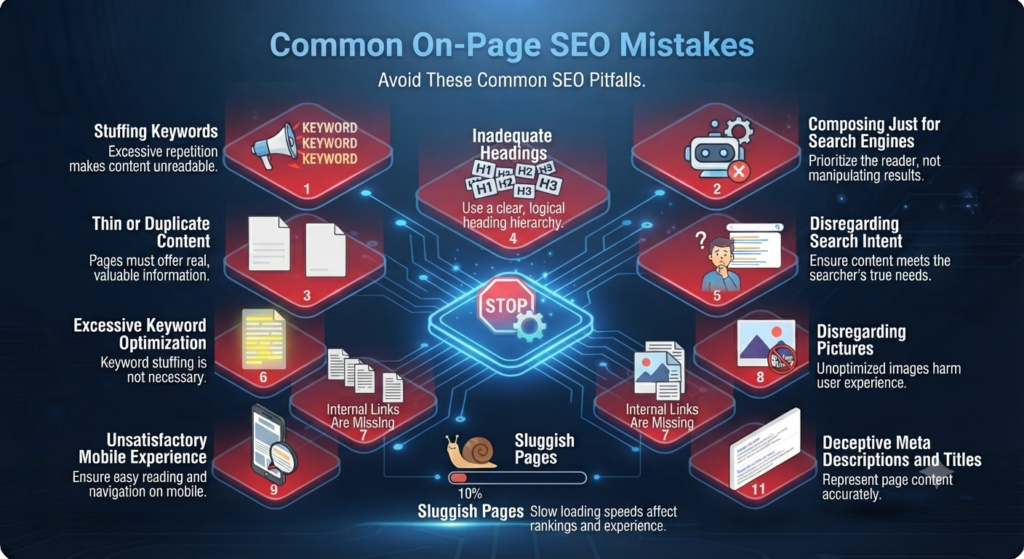
Common On-Page SEO Mistakes
Even beginners can avoid many SEO problems by knowing what not to do.
Stuffing Keywords
Excessive repetition of a single keyword can make material awkward and challenging to read.
Composing Just for Search Engines
Assisting the reader should be your top priority. Instead of content that is largely produced to manipulate results, Google promotes content that prioritizes individuals.
Thin or Duplicate Content
A bad experience could result from pages that don’t include much valuable information. Instead, try to add real value.
Inadequate Headings
An article may become challenging to navigate if headings are used haphazardly.
Disregarding Search Intent
Even if a page targets the correct keyword, it may not meet the searcher’s actual needs.
Excessive Keyword Optimization
It is not necessary to include the precise term in each heading or paragraph
Internal Links Are Missing
To help visitors find related information, important pages should be linked where appropriate.
Disregarding Pictures
The user experience may be adversely affected by large, unnecessary, or improperly handled graphics.
Unsatisfactory Mobile Experience
The overall experience is negatively impacted if users find it difficult to read or navigate your page on a phone.
Sluggish Pages
Slow loading speeds can be caused by large graphics, superfluous scripts, and poorly optimized websites.
Deceptive Meta Descriptions and Titles
What users will find on the page should be appropriately represented by the information in your search results.
On-Page SEO Best Practices for 2026
Although SEO is still changing, many principles are still the same.
To help visitors find related information, important pages should be linked where appropriate.
Make Content with People First
Prioritize the audience when writing. Instead than just attempting to draw search engine traffic, content should offer real value.
Match the Intent of the Search
Prior to choosing what information to add, find out what users want.
Make Use of Natural Language
Avoid using exact-match keywords in every sentence. Relationships between concepts and associated language can be understood by search engines.
Develop Topical Relevance
Discuss significant subtopics that aid readers in fully comprehending the main theme.
Enhance the User Experience
A better page experience is influenced by readable layouts, practical navigation, mobile usability, and strong performance.
Maintain Current and Accurate Information
To help visitors find related information, important pages should be linked where appropriate.
Examine significant articles on a regular basis, especially when tools, data, or business procedures change.
Get Ready for Contemporary Search Experiences
According to Google’s most recent guidelines, current SEO principles are still applicable to AI Overviews and AI Mode. These AI features don’t require a different set of unique improvements.
This implies that you should continue to concentrate on sites that are technically accessible, material that is helpful, a clear structure, internal linking, and a positive overall experience.
These are some of the most long-lasting SEO strategies for creating a functional website.
Frequently Asked Questions
What is On-Page SEO in simple words?
On-Page SEO means optimizing elements on your webpage—such as content, titles, headings, URLs, images, and links—to make the page easier for users and search engines to understand.
Why is On-Page SEO important?
It helps communicate the topic and structure of your webpage while improving the experience for visitors. It can also support your website’s visibility in organic search.
What are the main On-Page SEO factors?
Important factors include title tags, headings, useful content, search intent, URLs, internal links, image optimization, mobile usability, page experience, and content readability.
What is the difference between On-Page SEO and Off-Page SEO?
On-Page SEO focuses primarily on elements you can optimize on your own website. Off-Page SEO focuses on external signals and activities, such as earning relevant backlinks and building visibility beyond your website.
How do I start On-Page SEO?
Start by understanding your audience and search intent. Then perform keyword research, create useful content, optimize your title and headings, improve your URL, add internal links, optimize images, and check the page’s mobile experience and performance.
Is keyword density important for On-Page SEO?
There is no ideal keyword-density percentage you need to achieve. Focus on using relevant terms naturally while creating useful content for readers.
Does On-Page SEO improve Google rankings?
On-Page SEO can help search engines understand your content and can support a site’s search visibility, but no individual optimization guarantees a specific Google ranking. Google states that even meeting its technical requirements and best practices does not guarantee that a page will be crawled, indexed, or served in search results.
Conclusion
One of the core components of SEO that every blogger, digital marketer, and website owner should comprehend is on-page SEO. To help visitors find related information, important pages should be linked where appropriate.
It entails optimizing the text, titles, headings, URLs, internal links, pictures, and user experience of your webpages.
Filling a site with keywords is not the goal of effective on-page SEO strategies. Rather, they entail comprehending search intent, producing useful content, clearly arranging information, and making the website simple to use for both users and search engines.
When learning SEO, start with the fundamentals: conduct audience research, select pertinent keywords, provide informative content, optimize your page structure, link similar pages with internal links, and conduct frequent website reviews.
To help visitors find related information, important pages should be linked where appropriate.
When these principles are constantly followed, SEO optimization becomes less about pursuing specific ranking strategies and more about creating a website that actually benefits its users.