
SEO

on page seo, SEO, seo

What is On-Page SEO? A Complete Beginner’s Guide to On-Page SEO

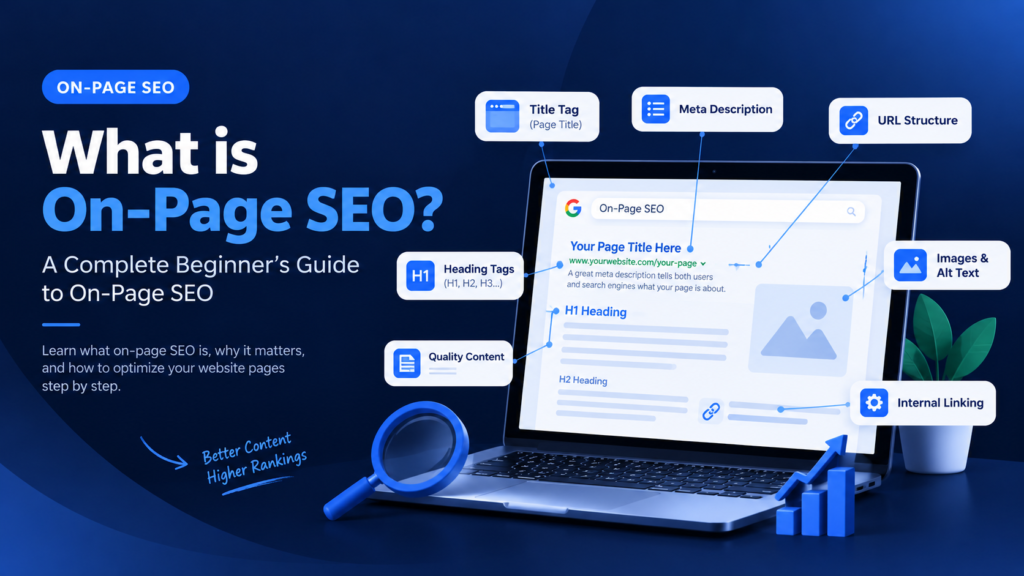
What is On-Page SEO? A Complete Beginner’s Guide to On-Page SEO Making quality content for your website is just one aspect of getting found online. Additionally, you must ensure that each page is easily readable, navigable, and usable by search engines. On-Page SEO is crucial in this situation. To put it simply, On-Page SEO is the process of making improvements to your websites so that visitors can more quickly access relevant information and search engines can comprehend your material. Titles, headings, URLs, content, internal links, pictures, and the user experience as a whole are all included. Google’s current guidelines still place a strong emphasis on basic SEO techniques and helpful, trustworthy, people-first content. These principles also hold true as Google Search incorporates more AI-powered features. Understanding On-Page SEO provides you with a useful basis for enhancing your website, regardless of whether you are a blogger, a business owner running a website, or a novice studying digital marketing. What Is On-Page SEO? The optimization of components that are immediately on a webpage is known as “on-page SEO.” The objective is to improve the page’s comprehensibility for both users and search engines. Because search engines must evaluate a webpage’s content, structure, and purpose before determining how it connects to a user’s search query, it is a crucial component of search engine optimization. Assume, for instance, that you write a piece titled “digital marketing for small businesses.” Appropriate website optimization may entail: Creating a descriptive titleUsing a clear H1 headingOrganizing information with H2 and H3 headingsNaturally using relevant keywordsWriting useful and original contentCreating a readable URLAdding relevant internal linksOptimizing images and alt textMaking the page easy to use on mobile devices The website itself is where this kind of SEO optimization mostly takes place. Off-Page SEO, which typically entails actions outside of your own webpage, such as obtaining backlinks, creating brand mentions, and establishing online authority, is distinct from On-Page SEO. Why Is On-Page SEO Important? In addition to enhancing the user experience, effective on-page SEO can assist search engines in comprehending the topic and applicability of a webpage. It matters for the following significant reasons: 1. Helps Search Engines Understand Your Content A webpage’s text, headings, links, graphics, and page structure are all examined by search engines. A page’s topic is easier to understand when it has clear material and descriptive details. 2. Helps Match Content With Search Intent The purpose of a search for “what is SEO?” differs from that of a search for “SEO agency near me.” You may produce content that truly addresses the visitor’s search query by having a thorough understanding of search intent. 3. Enhances the User Experience Search engines are just one aspect of effective SEO. A page is more user-friendly when it has clear headings, intelligible content, helpful links, optimized pictures, and simple navigation. 4. Promotes Visibility in Organic Search Stronger contextual information about a page’s content can be provided to search engines through optimization. But optimization by itself does not ensure a specific ranking. Google makes it clear that crawling, indexing, and ranking are not guarantyd by adhering to SEO best practices. 5. Improves Website Organization A website can be made easier for users and search engines to navigate by using consistent headings, URLs, internal links, and well-organized material. How Does On-Page SEO Work? Lorem ipsum dolor sit amet, consectetur adipiscing elit. Ut elit tellus, luctus nec ullamcorper mattis, pulvinar dapibus leo. Automated systems are used by search engines to find, crawl, comprehend, and index webpages. As a result, your page should make it obvious what its subject and goal are. Important elements include: Page content: Provides a thorough explanation of the topic. Keywords: Describe the vocabulary that users use when conducting searches. Title tag: Provides a concise description of the page. Headings: Divide the text into sections that make sense. Meta description: Can summarize the page for users in search results. URL: Offers an additional informative signal about the page. Internal links: Link similar pages together on your website. Images: When correctly optimized, they can complement the written information. Search intent: Assists in making sure the user’s purpose is met by the content. In particular, Google’s Search Essentials advises employing terms that readers might use to find your material in prominent and descriptive places like headings, titles, alt text, and link text. Important On-Page SEO Factors 1. The title tag One of the first things visitors may see when your website shows up in search results is the title tag. A good title should be pertinent to the page, succinct, and descriptive. For instance: Bad: Homepage Better: A Comprehensive Beginner’s Guide to On-Page SEO Google advises against ambiguous or overly lengthy titles in favor of clear and succinct title language. 2. Meta Description A brief synopsis of a webpage is given in a meta description. A helpful description can assist viewers understand what to expect from the page, even though it is more than just a tool for adding keywords. For instance: Discover the most crucial optimization elements, learn what On-Page SEO is, and use a useful checklist to enhance your website. Make the description of each significant page distinct and pertinent. 4. Headings Your content is arranged using headings. A common structure might be: H1: What Is On-Page SEO? H2: Why Is On-Page SEO Important? H2: Important On-Page SEO Factors H3: Title Tag H3: Meta Description H3: Internal Linking Make use of a single, distinct H1 and use H2 and H3 headings to logically arrange supporting sections. 5. Placement of Keywords Although they should be employed organically, keywords aid in conveying the content of a page. When applicable, include your primary theme, such as: Headline primary heading Overview Subheadings that are relevant URL for body content when appropriate When descriptive and pertinent, image alt text To improve keyword density, don’t repeat a word in an artificial way. 6. Superior Content The core of contemporary SEO is useful content. Concentrate on fully addressing the reader’s questions rather than crafting an article just
SEO

SEO Trends in 2026: What Every Business Needs to Know to Stay Ahead

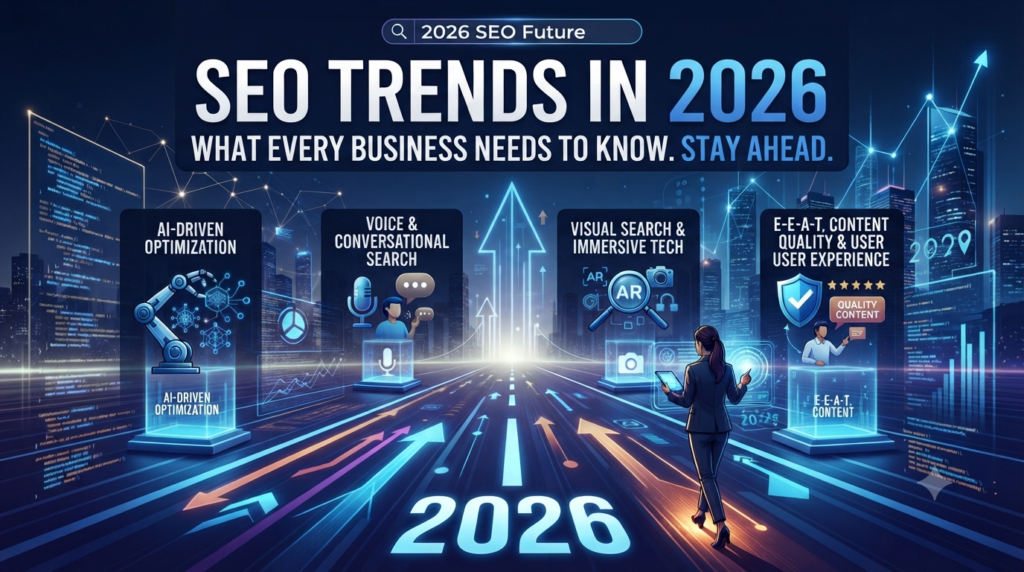
Search Engine Optimization (SEO) has always been one of the most effective ways to generate organic traffic, build brand authority, and attract potential customers. However, in 2026, SEO is evolving faster than ever before. Artificial intelligence is transforming how people search online. Instead of simply typing keywords into Google, users are now asking complete questions through AI-powered search tools and expecting instant, accurate answers. Search engines are becoming smarter, and businesses that continue using outdated SEO strategies risk losing valuable visibility. The good news is that SEO is far from dead. In fact, it’s becoming more exciting and more focused on quality than ever before. In this guide, we’ll explore the biggest SEO trends shaping 2026 and explain how your business can stay ahead of the competition. Why SEO Matters More Than Ever Millions of searches happen every day, but users are becoming more selective about which results they trust. Search engines now prioritize websites that provide valuable, accurate, and helpful information rather than those that simply repeat keywords. Businesses investing in modern SEO enjoy benefits such as: Higher organic traffic Better brand credibility Increased qualified leads Lower customer acquisition costs Long-term online visibility SEO has shifted from simply ranking pages to becoming the most trusted answer for users. AI-driven search experiences are making authority, structured content, and expertise even more important. 1. AI Search Is Reshaping SEO Artificial intelligence is changing the way search engines understand content. Instead of matching exact keywords, AI evaluates context, user intent, expertise, and overall usefulness. Modern search experiences summarize information directly within search results, making content quality more important than ever. To succeed: Write naturally for humans. Cover topics in depth. Answer common questions. Use clear headings. Include original insights and examples. Businesses creating genuinely useful content have a much better chance of appearing in both traditional search results and AI-generated answers. 2. Answer Engine Optimization (AEO) Is Becoming Essential One of the biggest changes in 2026 is the rise of Answer Engine Optimization (AEO). Instead of optimizing only for Google rankings, businesses should also optimize content so AI assistants can reference it when answering user questions. To improve your AEO strategy: Answer questions directly. Add FAQ sections. Use simple language. Structure content with headings. Include trustworthy sources and original information. SEO remains the foundation, while AEO builds on it by helping content become a trusted citation for AI-generated answers. 3. Search Intent Is More Important Than Keywords Keyword stuffing disappeared years ago. In 2026, successful SEO focuses on understanding why someone searches. Every search falls into one of several categories: Informational Commercial Transactional Navigational If someone searches “best SEO agency for small businesses,” they likely want recommendations—not a definition of SEO. Creating content that matches search intent leads to higher rankings and better engagement. 4. High-Quality Content Wins Every Time Publishing dozens of average articles no longer works. Instead, create content that: Solves real problems. Includes practical examples. Shares unique insights. Uses clear formatting. Is regularly updated. Google and AI search systems reward content that demonstrates expertise, experience, authority, and trustworthiness rather than generic articles. 5. E-E-A-T Is a Major Ranking Factor E-E-A-T stands for: Experience Expertise Authoritativeness Trustworthiness Search engines increasingly reward websites that clearly demonstrate these qualities. Ways to improve E-E-A-T include: Publishing expert-written content. Displaying author information. Keeping information accurate. Citing reliable sources when appropriate. Maintaining an updated website. Trust is becoming one of the strongest competitive advantages in SEO. 6. User Experience Directly Impacts Rankings Even excellent content can struggle if your website provides a poor experience. Focus on: Fast loading speed Mobile responsiveness Easy navigation Readable typography Secure HTTPS connection Minimal intrusive pop-ups A positive user experience keeps visitors engaged and encourages them to explore more pages. 7. Topic Authority Beats Individual Keywords Instead of publishing isolated articles targeting single keywords, build complete topic clusters. For example, if your website focuses on digital marketing, create related content around: SEO Local SEO Technical SEO Content Marketing AI Marketing Google Ads Social Media Marketing Interlink these pages naturally. This helps search engines understand your expertise and improves rankings across multiple keywords. 8. Video SEO Continues to Grow Video content is becoming increasingly important. Short tutorials, explainers, and educational videos often appear directly in search results. Optimize videos by: Writing descriptive titles. Using relevant keywords naturally. Adding transcripts. Creating engaging thumbnails. Embedding videos within related blog posts. Video keeps users engaged and increases the time they spend on your website. 9. Voice and Conversational Search People now search more naturally. Instead of typing: “SEO tips” They ask: “What are the best SEO strategies for a small business in 2026?” Your content should answer complete questions using conversational language. Including FAQ sections can significantly improve visibility for voice searches and AI assistants. 10. Technical SEO Still Matters While content is critical, technical SEO remains essential. Regularly check: Broken links Crawl errors XML sitemaps Robots.txt Duplicate content Image optimization Internal linking Structured data A technically healthy website allows search engines to crawl and index content more efficiently. 11. Brand Authority Is Becoming a Strong Ranking Signal Search engines increasingly recognize trusted brands. Build authority by: Publishing consistently. Earning quality backlinks. Encouraging customer reviews. Being active on social media. Maintaining consistent branding. A recognizable brand is more likely to earn clicks, mentions, and trust. 12. Local SEO Remains Crucial For businesses serving specific locations, local SEO continues to deliver excellent results. Optimize by: Keeping business information accurate. Encouraging genuine customer reviews. Publishing location-specific content. Optimizing your Google Business Profile. Using local keywords naturally. Local visibility often leads to higher conversion rates because searchers usually have strong purchase intent.

Scroll to Top